



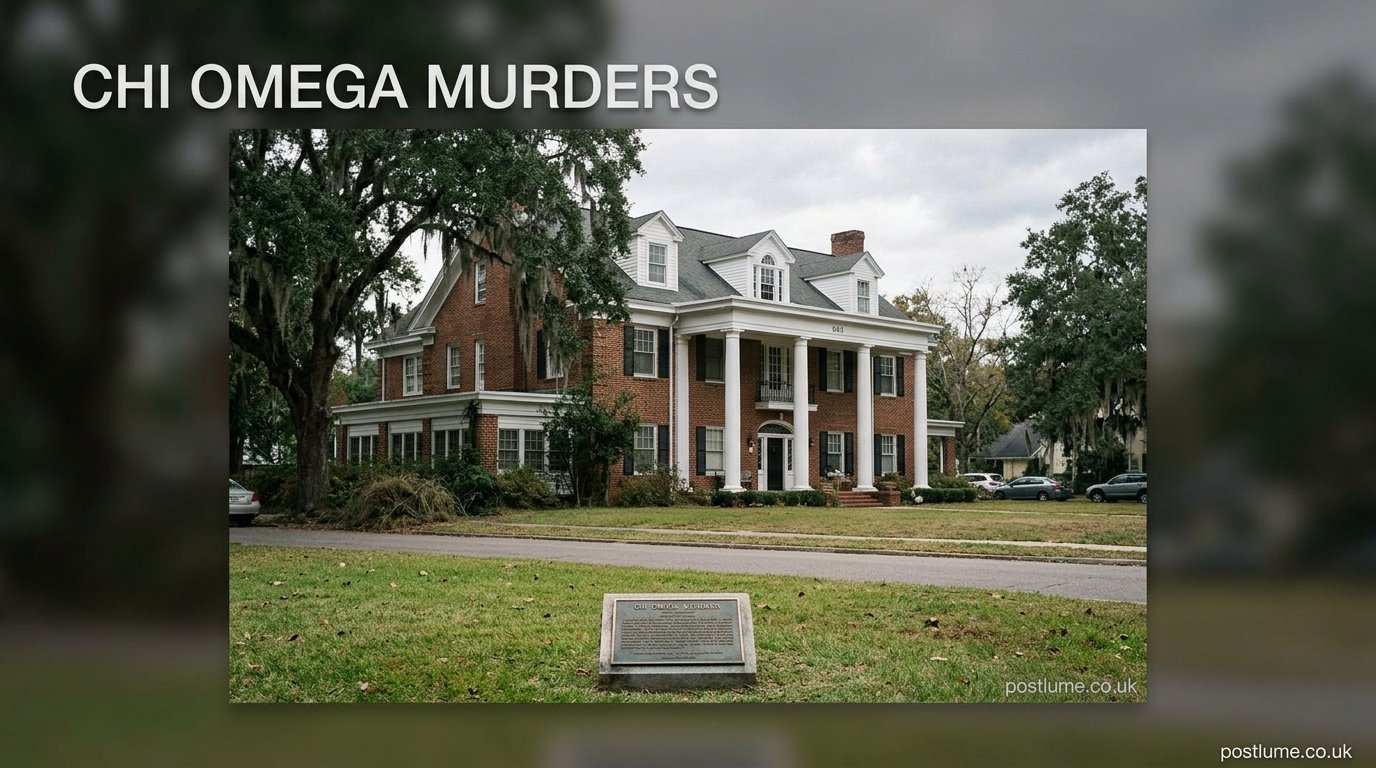
The phrase “Chi Omega murders” refers to one of the most infamous crimes in American criminal history. In the early morning hours of January 15, 1978, serial killer Ted Bundy entered the Chi Omega murders sorority house at Florida State University in Tallahassee, Florida, and brutally attacked several young women. The attack left two women dead and two others seriously injured, permanently changing the university community and shocking the nation.
The victims who lost their lives were Margaret Bowman and Lisa Levy, both members of the Chi Omega sorority. Survivors Kathy Kleiner and Karen Chandler suffered severe injuries but lived to later share their experiences publicly. The crime occurred during Bundy’s final murder spree after he escaped custody in Colorado only weeks earlier.
The Chi Omega murders remain one of the most widely studied criminal cases in American history because they represented a terrifying escalation in Bundy’s violent behavior. The brutality of the attacks, the public fear they generated, and the intense media coverage helped cement the case as a defining moment in discussions about serial crime in the United States.
Who Was Ted Bundy Before the Chi Omega Murders?
Before arriving in Florida, Ted Bundy had already become a suspected serial killer connected to numerous disappearances and murders across several western states. Investigators linked Bundy to attacks in Washington, Utah, Colorado, Idaho, and Oregon during the 1970s. He later confessed to murdering at least 30 women, though investigators believe the true number may have been higher.
Bundy initially appeared intelligent, charismatic, and socially skilled, which contributed to the difficulty authorities faced in identifying him during the early years of his crimes. He often used manipulation and deception to gain victims’ trust before attacking them. His public image later became a disturbing example of how dangerous individuals can hide behind outward charm and normal behavior.
In 1977, Bundy escaped from custody in Colorado while awaiting trial for murder charges. After fleeing across multiple states, he eventually arrived in Tallahassee, Florida, where he rented a room under a false identity near the Florida State University campus. Only days later, the Chi Omega murders occurred.
What Happened Inside the Chi Omega Sorority House
During the early morning hours of January 15, 1978, Bundy entered the Chi Omega sorority house through a back door reportedly affected by a faulty lock. Once inside, he moved through the house attacking sleeping students in separate rooms.
Margaret Bowman and Lisa Levy were murdered during the attack. Kathy Kleiner and Karen Chandler survived but suffered devastating injuries, including broken jaws, severe facial trauma, and concussions. Investigators later determined the attacks happened within a remarkably short period of time while many students in the house remained asleep or unaware of the violence occurring nearby.
After leaving the sorority house, Bundy entered another nearby residence and attacked Florida State University student Cheryl Thomas, who also survived. The rapid succession of violent attacks shocked investigators and intensified fears throughout the Tallahassee community.
The Chi Omega murders represented one of the final violent episodes in Bundy’s criminal history before his eventual capture later in 1978.
The Victims and Survivors of the Chi Omega Murders
The tragedy deeply affected the families, friends, and university community connected to the victims. Margaret Bowman was a 21-year-old student remembered for her academic success and leadership qualities. Lisa Levy, age 20, was also described by friends and classmates as kind, energetic, and socially active within the sorority community.
Survivors Kathy Kleiner and Karen Chandler later became important voices in public discussions about trauma recovery and victim resilience. Kathy Kleiner, in particular, has spoken publicly in interviews and documentaries about surviving the attack and rebuilding her life afterward.
The emotional impact of the crimes extended far beyond Florida State University. Many Americans followed the story closely through newspapers and television coverage, contributing to nationwide fear surrounding serial crimes during the late 1970s.
The survivors’ willingness to later share their experiences helped humanize the victims and shifted some public attention away from the criminal himself toward those whose lives were permanently altered by the violence.
The Investigation That Led to Bundy’s Capture
Law enforcement agencies launched an intense investigation immediately after the Chi Omega murders. Witness statements, forensic evidence, and physical descriptions gradually helped investigators connect the attacks to Bundy, who was already a fugitive.
One important piece of evidence involved bite mark analysis, which prosecutors later used during Bundy’s trial. Although forensic dentistry has become more controversial in modern criminal justice discussions, bite mark evidence played a major role in the original case against Bundy during the late 1970s.
Bundy remained in Florida after the murders and continued committing crimes until his eventual arrest in February 1978. He was captured by police in Pensacola after a stolen vehicle stop raised suspicion. Investigators soon connected him to the Tallahassee attacks and other murders.
The case became a landmark moment in American criminal investigations because of its extensive media coverage, courtroom attention, and evolving forensic techniques.
Media Coverage and Public Fascination With the Case
The Chi Omega murders received enormous national attention due to the horrifying nature of the crimes and Bundy’s growing notoriety. News outlets covered every stage of the investigation, arrest, and trial extensively.
Bundy’s courtroom behavior attracted unusual media interest because he often represented himself during portions of the trial and appeared unusually calm despite facing severe charges. His televised court appearances contributed to his infamy and created widespread public fascination.
Many criminologists and media analysts later criticized how the public narrative sometimes focused too heavily on Bundy’s personality instead of the victims and survivors. Discussions surrounding the case helped spark broader conversations about sensationalism in true crime reporting.
The first nationally televised murder trial in the United States involved Bundy’s Florida proceedings, further increasing public attention and transforming the case into a defining moment in American crime media history.
How the Chi Omega Murders Influenced Campus Safety
The attacks at the Chi Omega house significantly changed discussions about campus security and student safety across the United States. Universities and sorority organizations reevaluated security practices, building access procedures, and emergency response systems following the murders.
At the time, many college campuses maintained relatively open residential environments with minimal security restrictions. Students often felt safe walking late at night or leaving doors unlocked. The Chi Omega murders challenged those assumptions dramatically.
Over time, colleges implemented stronger dormitory protections, surveillance systems, visitor policies, and emergency communication procedures. Modern campus security strategies owe part of their development to lessons learned from violent incidents such as the Chi Omega murders.
The tragedy also contributed to increased public awareness regarding violent offenders, serial crime investigations, and personal safety practices during the late twentieth century.
Survivor Stories and Long-Term Trauma
The emotional and psychological effects of violent crime often continue long after media coverage ends. Survivors of the Chi Omega attacks faced years of physical recovery, emotional trauma, and public attention connected to the case.
Kathy Kleiner later described her determination not to allow Bundy’s crimes to define her entire life. In interviews and public appearances, she emphasized resilience, healing, and personal growth despite the severity of her injuries and trauma.
Trauma experts note that survivors of violent attacks frequently experience long-term emotional challenges including anxiety, grief, and post-traumatic stress. Public exposure connected to highly publicized crimes can further complicate the healing process.
The stories of the survivors remain important reminders that criminal cases involve real human suffering beyond the sensational headlines often associated with true crime media.
The Legacy of the Chi Omega Murders in True Crime History
Decades later, the Chi Omega murders continue to be examined in documentaries, books, podcasts, criminology courses, and historical crime analyses. The case remains one of the most widely recognized examples of serial violence in modern American history.
The murders are often discussed alongside broader conversations about criminal psychology, law enforcement coordination, forensic science, and media ethics. Researchers continue studying Bundy’s crimes to better understand patterns of predatory violence and offender behavior.
Public interest in true crime stories has grown substantially in recent years through streaming platforms, podcasts, and online discussions. However, many experts encourage audiences to focus on honoring victims rather than glorifying offenders.
The Chi Omega murders continue to resonate because they combined fear, tragedy, media attention, and lasting social impact in ways that permanently influenced public understanding of serial crime.
Remembering the Victims Rather Than the Killer
While Ted Bundy remains one of the most infamous criminals in American history, many people believe the focus should remain on the lives of Margaret Bowman, Lisa Levy, and the survivors affected by the attacks.
Public conversations increasingly emphasize victim-centered storytelling rather than sensationalizing violent offenders. This shift reflects growing awareness about the emotional consequences of true crime media and the importance of respectful historical discussion.
The Chi Omega murders are remembered not only because of the violence itself but because of the resilience shown by survivors, families, investigators, and the Florida State University community during an extremely painful period.
Today, the case continues serving as both a historical warning about violent crime and a reminder of the lasting human impact left behind by acts of brutality.
