



The concept of independent assortment is one of the foundational principles of genetics that explains how traits are passed from parents to offspring. First introduced by Gregor Mendel in the 19th century, this principle helps scientists understand why individuals inherit unique combinations of characteristics. It plays a central role in heredity, variation, and the study of genetic inheritance.
At its core, independent assortment explains that genes for different traits are inherited independently of one another. This means that the inheritance of one trait does not influence the inheritance of another. For example, the gene that determines eye color is inherited independently of the gene that determines hair texture, provided they are not linked.
In modern biology, this principle is essential for understanding how genetic diversity arises in populations. It also forms the basis for predicting inheritance patterns, making it a critical concept for students, researchers, and professionals in the field of genetics.
The Historical Discovery of Independent Assortment
The origin of independent assortment lies in the groundbreaking experiments conducted by Gregor Mendel. Mendel studied pea plants and carefully observed how traits were passed from one generation to the next. His experiments involved crossbreeding plants with different characteristics, such as seed color and shape.
Through these experiments, Mendel discovered that traits did not always appear together as they did in the parent plants. Instead, new combinations of traits appeared in the offspring. This observation led him to propose the law of independent assortment, which explained that different traits are inherited separately.
Mendel’s work was revolutionary because it introduced a scientific framework for understanding heredity. Although his findings were not widely recognized during his lifetime, they later became the foundation of modern genetics and continue to influence scientific research today.
Definition and Basic Concept of Independent Assortment
In simple terms, independent assortment refers to the process by which different pairs of genes separate independently during the formation of reproductive cells. This means that the allele a gamete receives for one gene does not affect the allele received for another gene.
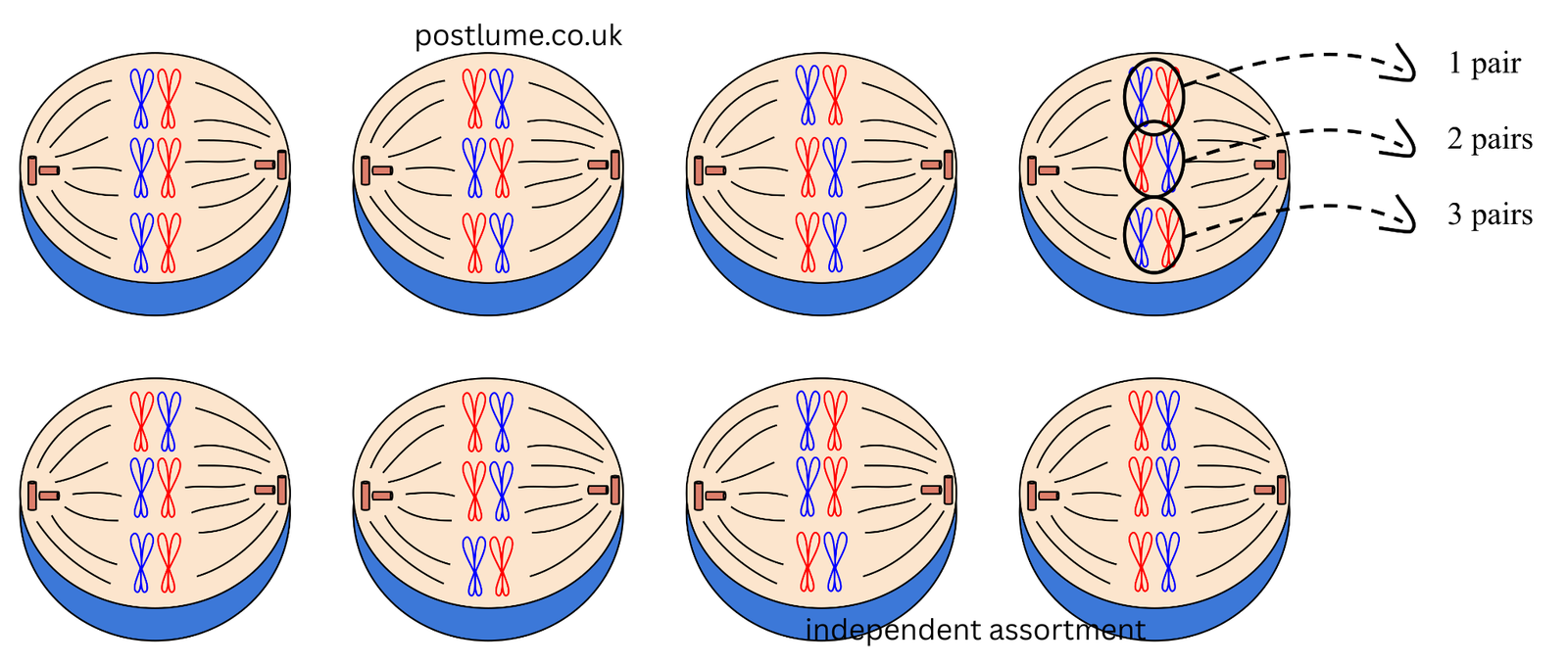
This principle applies during meiosis, the type of cell division that produces gametes such as sperm and egg cells. During this process, chromosomes are distributed randomly into the resulting cells, leading to a variety of genetic combinations.
As a result, offspring inherit a mix of traits that may differ from both parents. This randomness is a key factor in genetic diversity, allowing populations to adapt and evolve over time.
Role of Meiosis in Independent Assortment
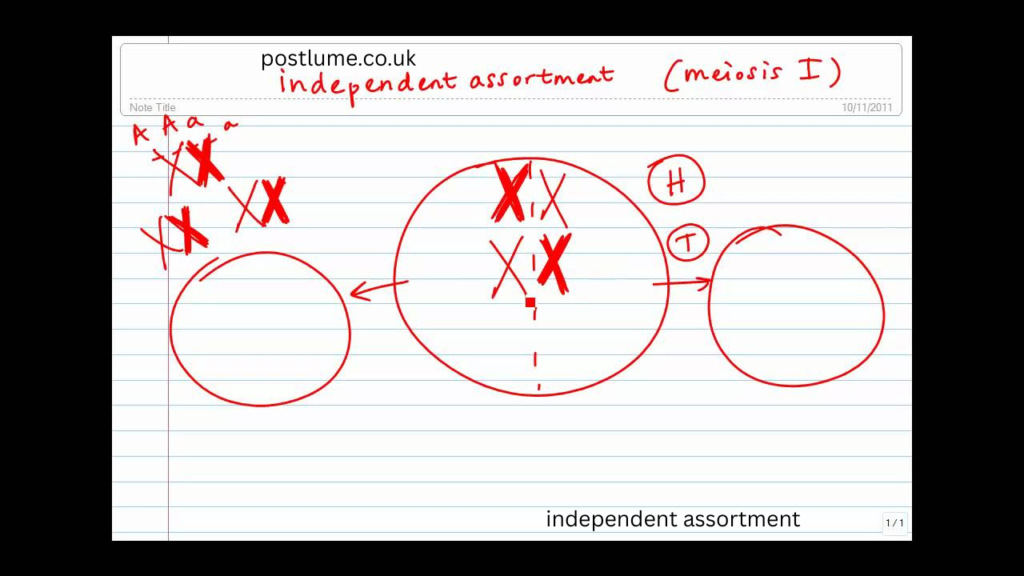
The process of independent assortment occurs during meiosis, specifically during a stage called metaphase I. At this stage, pairs of homologous chromosomes align randomly along the center of the cell.
Because the alignment is random, each pair of chromosomes can separate independently of the others. This means that the combination of chromosomes in each gamete is unique. The result is a wide range of possible genetic combinations in the offspring.
This randomness is essential for sexual reproduction. Without it, offspring would inherit identical combinations of traits, reducing genetic diversity and limiting the ability of populations to adapt to changing environments.
Mendel’s Experiments and Dihybrid Crosses
To demonstrate independent assortment, Gregor Mendel conducted dihybrid crosses, which involve studying the inheritance of two traits simultaneously. For example, he crossed pea plants with different seed colors and shapes.
Mendel observed that the traits appeared in specific ratios in the offspring, typically 9:3:3:1. This pattern indicated that the traits were inherited independently rather than together.
These experiments provided strong evidence for the law of independent assortment and helped establish the mathematical principles of genetics. They also demonstrated how probability can be used to predict inheritance patterns.
Importance of Independent Assortment in Genetic Variation
One of the most significant roles of independent assortment is its contribution to genetic variation. By producing different combinations of alleles, this process ensures that each individual is genetically unique.
Genetic variation is essential for evolution and natural selection. It allows populations to adapt to environmental changes and increases the chances of survival for certain traits.
Without independent assortment, genetic diversity would be limited, making it more difficult for species to respond to challenges such as diseases or climate changes.
Independent Assortment vs Genetic Linkage
While independent assortment explains how genes are inherited separately, it does not apply to all genes. Some genes are located close together on the same chromosome and tend to be inherited together. This phenomenon is known as genetic linkage.
When genes are linked, they do not assort independently because they are physically connected. However, processes such as crossing over during meiosis can sometimes separate linked genes, allowing for some level of variation.
Understanding the difference between independent assortment and genetic linkage is important for accurately predicting inheritance patterns. It highlights the complexity of genetics beyond Mendel’s original observations.
Applications of Independent Assortment in Modern Science
The principle of independent assortment has many applications in modern science. It is used in genetic research to study inheritance patterns and predict the likelihood of certain traits appearing in offspring.
In medicine, this concept helps researchers understand genetic disorders and how they are passed down through families. It also plays a role in genetic counseling, where individuals receive information about the risk of inherited conditions.
In agriculture, independent assortment is used in breeding programs to develop crops with desirable traits, such as disease resistance or higher yield. By understanding how traits are inherited, scientists can create better plant and animal varieties.
Limitations of Independent Assortment
Although independent assortment is a fundamental principle, it has limitations. It applies only to genes that are located on different chromosomes or far apart on the same chromosome.
When genes are closely linked, they do not assort independently, which can affect inheritance patterns. This limitation shows that genetics is more complex than Mendel originally proposed.
Modern genetics has expanded on Mendel’s work by incorporating concepts such as DNA structure, gene mapping, and molecular biology. These advancements provide a more complete understanding of how traits are inherited.
Conclusion
The concept of independent assortment remains one of the most important principles in genetics. First discovered by Gregor Mendel, it explains how different traits are inherited independently, leading to genetic diversity.
From its origins in pea plant experiments to its applications in modern science, independent assortment continues to shape our understanding of heredity. It highlights the role of randomness in genetic inheritance and the importance of variation in evolution.
By understanding this principle, we gain valuable insight into how life evolves and how traits are passed from one generation to the next. Independent assortment is not just a theory; it is a cornerstone of biology that continues to influence research, medicine, and everyday life.
