



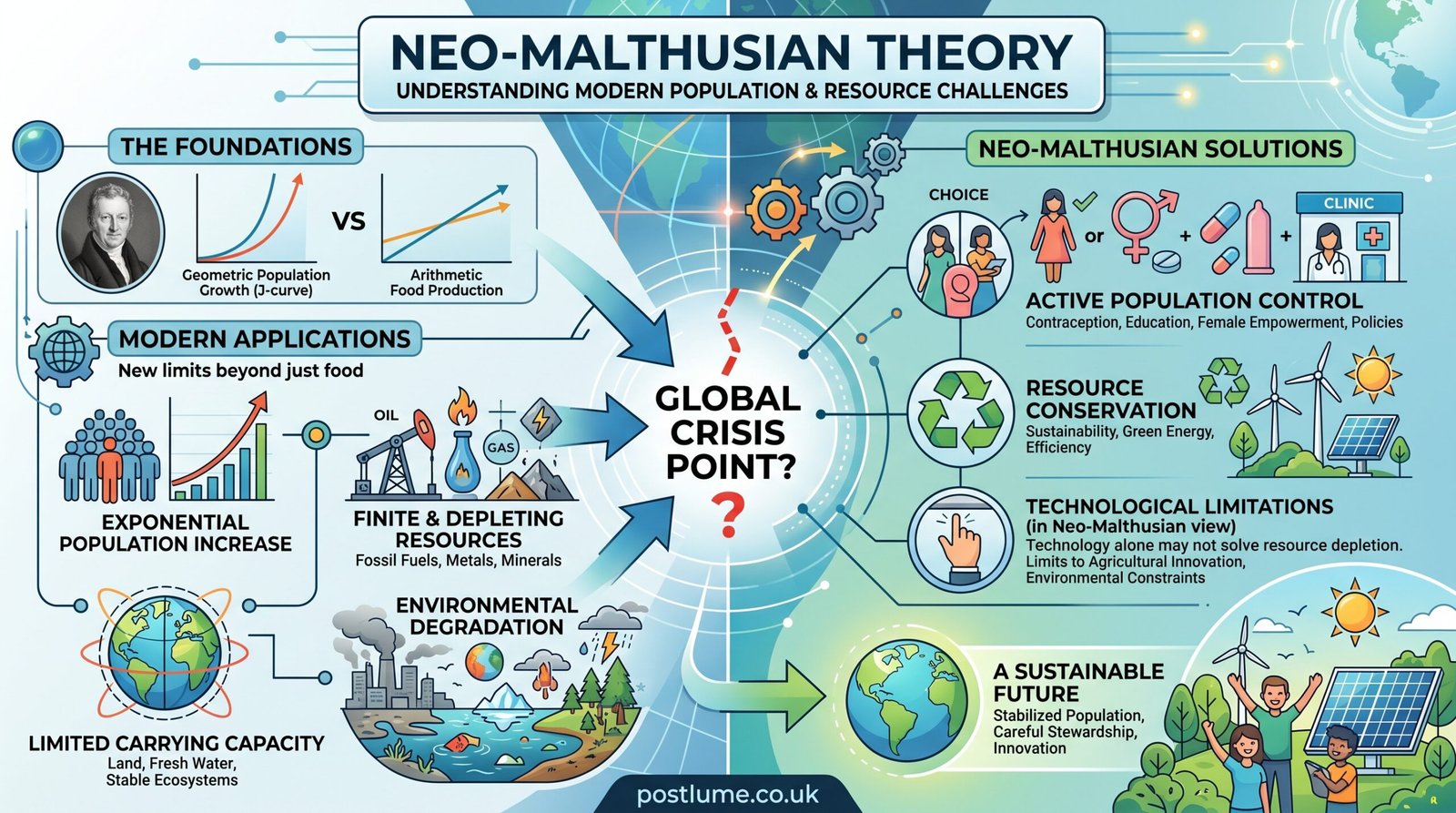
The Neo Malthusian theory is a modern interpretation of the ideas originally proposed by the British economist and scholar Thomas Robert Malthus. Malthus argued in the late eighteenth century that population growth tends to increase faster than food production, eventually creating pressure on resources, poverty, famine, and social instability. neo malthusian theory expands these concerns by focusing not only on food supply but also on environmental sustainability, natural resources, pollution, and global development.
neo malthusian theory believe that unchecked population growth can place enormous stress on ecosystems, economies, and public services. According to this theory, rapid population increase may contribute to climate change, water shortages, deforestation, unemployment, housing crises, and declining living standards in densely populated regions.
Unlike classical Malthusian theory, neo malthusian theory strongly supports modern birth control methods, family planning policies, reproductive education, and population management programs. These approaches are considered essential tools for maintaining balance between population growth and available resources.
The Historical Background of Neo Malthusianism
The foundations of Neo Malthusian theory originate from Thomas Malthus’s 1798 work “An Essay on the Principle of Population.” Malthus argued that while population tends to grow geometrically, food production increases arithmetically. He believed this imbalance would eventually create scarcity and social hardship.
During the nineteenth and twentieth centuries, scholars, economists, environmentalists, and policymakers revisited Malthus’s ideas in response to industrialization and global population growth. Neo Malthusianism emerged as a more modern adaptation that incorporated concerns about environmental degradation and resource depletion rather than focusing only on food shortages.
The rise of global environmental movements in the 1960s and 1970s significantly strengthened Neo Malthusian thinking. Books discussing overpopulation, pollution, and ecological collapse increased public awareness about the possible consequences of unsustainable population growth.
Core Principles of Neo Malthusian Theory
The Neo Malthusian theory is based on the belief that Earth’s natural resources are limited and cannot support unlimited human population growth indefinitely. Neo Malthusians argue that increasing population creates greater demand for food, energy, housing, transportation, and water resources.
Another important principle involves environmental sustainability. Neo Malthusians believe that rapid urbanization and industrial expansion contribute to deforestation, pollution, biodiversity loss, and climate-related challenges. They argue that controlling population growth is necessary for protecting long-term ecological balance.
The theory also emphasizes family planning and reproductive rights. Neo Malthusians generally support access to contraception, public health education, and voluntary birth control measures as practical ways to stabilize population growth and improve quality of life.
Population Growth and Resource Pressure
One of the central arguments of Neo Malthusianism is that rapid population growth increases pressure on finite resources. As populations expand, demand for agricultural land, freshwater supplies, fossil fuels, and infrastructure also rises significantly.
In many developing regions, population growth can outpace economic development and strain public services such as healthcare, education, transportation, and sanitation systems. Neo Malthusians believe this imbalance may contribute to poverty, unemployment, overcrowding, and food insecurity.
Environmental concerns are also deeply connected to resource pressure. Increased industrial production and urban expansion often lead to higher carbon emissions, deforestation, and ecosystem disruption. Neo Malthusians argue that sustainable population management is essential for reducing long-term environmental risks.
The Relationship Between Neo Malthusianism and Environmentalism
Modern environmental movements frequently intersect with Neo Malthusian ideas. Environmental activists and sustainability advocates often emphasize the connection between population growth and ecological stress.
Climate change discussions sometimes include Neo Malthusian perspectives because larger populations typically increase energy consumption and resource demand. Rapid urbanization and industrial activity can accelerate pollution and environmental degradation when not managed sustainably.
However, many environmental experts also emphasize that consumption patterns matter as much as population size. Wealthier societies with smaller populations may still produce higher environmental impacts due to intensive industrial activity and resource consumption.
Criticism of Neo Malthusian Theory
Neo Malthusian theory has faced significant criticism from economists, sociologists, and development experts. Critics argue that the theory often underestimates human innovation, technological progress, and agricultural advancements.
The Green Revolution of the twentieth century demonstrated that scientific improvements in farming, irrigation, fertilizers, and crop genetics could dramatically increase food production. Critics point out that global food output has grown faster than many early Neo Malthusian predictions anticipated.
Some scholars also argue that poverty and inequality are more closely connected to political and economic systems than population size alone. According to this view, unequal resource distribution and poor governance often create shortages even in areas with sufficient overall resources.
Neo Malthusianism in Modern Global Policy
Neo Malthusian ideas continue influencing international discussions about sustainability, urban planning, environmental protection, and public health policy. Governments and global organizations often promote family planning initiatives aimed at improving maternal health, reducing poverty, and supporting economic development.
Population stabilization policies are particularly discussed in regions experiencing rapid urban growth and infrastructure pressure. Access to education and reproductive healthcare is frequently considered essential for achieving sustainable demographic trends.
At the same time, modern policymakers generally avoid extreme population control approaches due to ethical concerns and human rights considerations. Contemporary population strategies focus more on voluntary education, healthcare access, and economic empowerment rather than coercive measures.
Technology and the Debate Over Population Limits
Technology remains one of the biggest challenges to Neo Malthusian predictions. Advances in agriculture, renewable energy, desalination, transportation, and medical science have expanded humanity’s ability to support larger populations.
Supporters of Neo Malthusianism acknowledge technological progress but argue that innovation alone cannot eliminate environmental limits permanently. They believe ecological systems still face risks from excessive consumption, pollution, and climate-related disruptions.
Critics counter that human creativity and scientific advancement continuously increase resource efficiency and production capacity. This debate remains central to discussions about sustainability, economic growth, and long-term environmental planning.
The Social and Ethical Dimensions of Population Control
Neo Malthusian theory also raises important ethical and social questions. Discussions about population control can become controversial when policies interfere with personal freedoms, reproductive rights, or cultural traditions.
Many modern scholars stress that ethical population policies should focus on education, healthcare, gender equality, and voluntary family planning rather than forced restrictions. Research consistently shows that improved education and economic opportunities often lead to lower birth rates naturally over time.
Women’s empowerment is another major aspect of modern population discussions. Access to reproductive healthcare and education has been linked to improved family well-being, lower infant mortality, and greater economic stability in many countries.
Neo Malthusian Theory and Climate Change Discussions
Climate change has renewed interest in Neo Malthusian ideas during the twenty-first century. Growing populations increase global energy demand, transportation needs, and industrial production, all of which contribute to greenhouse gas emissions.
Some environmental researchers argue that sustainable population growth should be considered alongside renewable energy development and conservation strategies. They believe long-term climate goals may become more difficult to achieve if population growth remains extremely rapid in vulnerable regions.
However, many climate experts also emphasize that consumption inequality plays a critical role. High-income countries with lower population growth may still contribute disproportionately to global emissions due to industrial activity and consumer lifestyles.
Final Thoughts on Neo Malthusian Theory
The Neo Malthusian theory remains one of the most influential and debated perspectives in discussions about population growth, sustainability, and environmental protection. By expanding upon the original ideas of Thomas Malthus, Neo Malthusians argue that humanity must carefully balance population trends with available natural resources and ecological limits.
Supporters believe the theory highlights important concerns related to environmental degradation, climate change, and resource scarcity. Critics argue that it underestimates technological innovation and oversimplifies the relationship between population and poverty.
Despite ongoing debate, Neo Malthusianism continues shaping conversations about sustainable development, family planning, urbanization, and environmental policy worldwide. As global populations and environmental challenges continue evolving, the theory remains highly relevant in modern academic, political, and economic discussions.
