



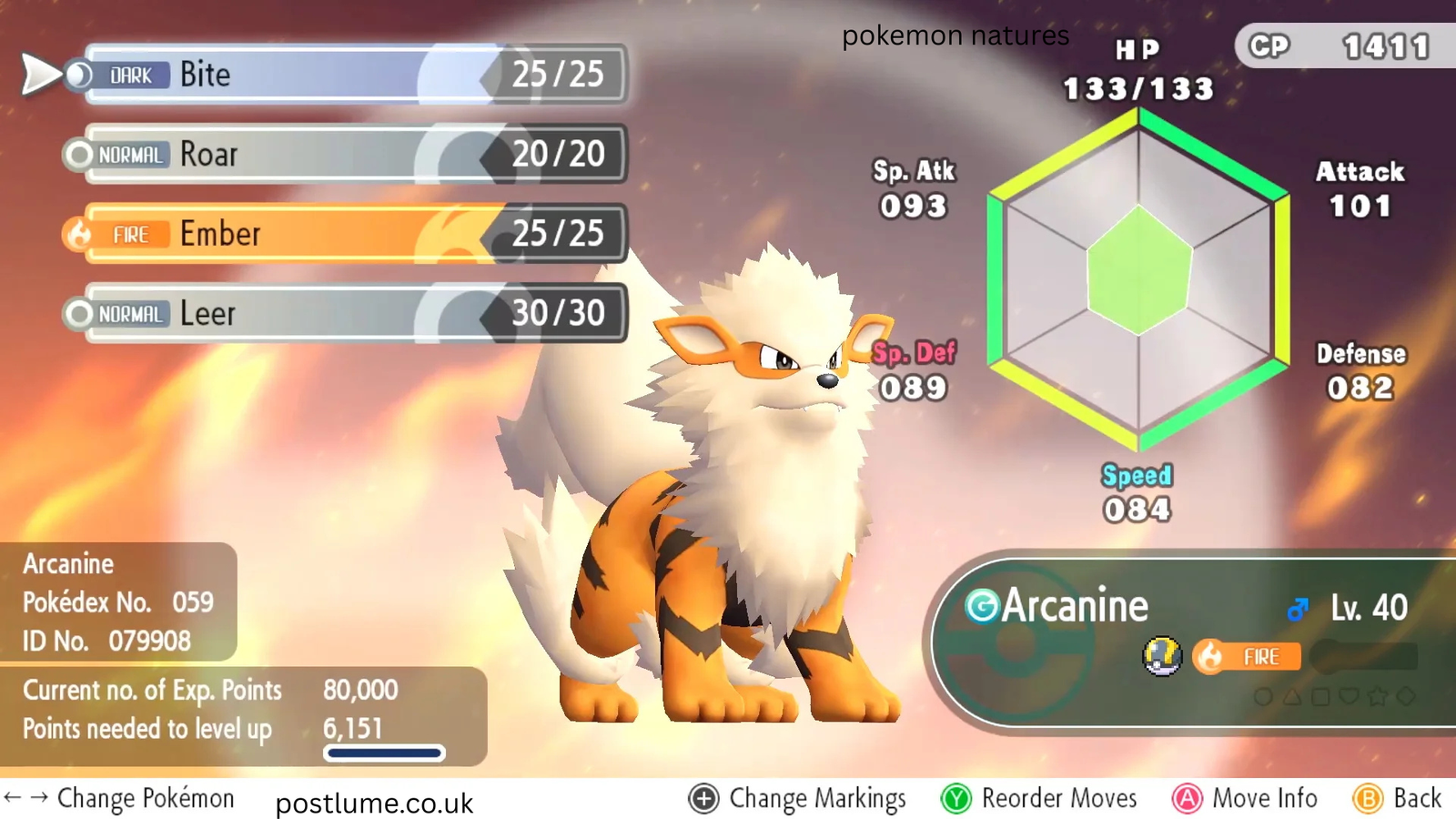
Every Pokémon you catch or breed comes with a nature — a hidden trait that quietly shapes how strong it becomes. Two Garchomp with identical IVs and EVs can perform very differently in battle if one has a Jolly nature and the other has a Brave nature. If you’ve ever wondered why your Pokémon feels a step behind (or ahead) of what the numbers suggest it should be, nature is usually the answer.
This guide breaks down what natures do, gives you the full chart, and tells you exactly how to pick the right one for the role you want your Pokémon to play.
What Is a Pokémon Nature?
A nature is a fixed trait assigned to a Pokémon the moment it’s caught, hatched, or received. It increases one stat by 10%, decreases a different stat by 10%, and leaves the rest untouched. There are 25 natures in total — 20 that affect stats and 5 “neutral” natures that change nothing.
Natures were introduced in Generation III (Ruby and Sapphire) and have stayed part of the core mechanics ever since. They’re permanent by default, though modern games give you a way to change them (more on that below).
Quick example: A Jolly nature raises Speed by 10% and lowers Special Attack by 10%. On a Pokémon like Dragonite, that trade makes sense if you want it to outspeed opponents and attack physically rather than with special moves.
Pokémon Natures Chart
Here’s the full list of stat-altering natures, what they raise, and what they lower.
| Nature | Raises | Lowers |
|---|---|---|
| Lonely | Attack | Defense |
| Brave | Attack | Speed |
| Adamant | Attack | Sp. Attack |
| Naughty | Attack | Sp. Defense |
| Bold | Defense | Attack |
| Relaxed | Defense | Speed |
| Impish | Defense | Sp. Attack |
| Lax | Defense | Sp. Defense |
| Timid | Speed | Attack |
| Hasty | Speed | Defense |
| Jolly | Speed | Sp. Attack |
| Naive | Speed | Sp. Defense |
| Modest | Sp. Attack | Attack |
| Mild | Sp. Attack | Defense |
| Quiet | Sp. Attack | Speed |
| Rash | Sp. Attack | Sp. Defense |
| Calm | Sp. Defense | Attack |
| Gentle | Sp. Defense | Defense |
| Sassy | Sp. Defense | Speed |
| Careful | Sp. Defense | Sp. Attack |
Every nature moves exactly one stat up and one stat down by 10%. HP is never affected by nature — it’s the one stat that stays out of this system entirely.
Neutral Natures
Five natures don’t change any stats at all:
- Hardy
- Docile
- Serious
- Bashful
- Quirky
These are useful in a narrow set of cases: if you’re going for a Pokémon that needs balanced stats across the board, if you’re breeding purely for IVs and don’t want to complicate the process with a Mint later, or if you simply landed on one by chance and the Pokémon’s role doesn’t depend heavily on the stat that would’ve been affected. Outside of those situations, most competitive players avoid neutral natures since a stat-boosting nature is almost always better once you know what role the Pokémon will play.
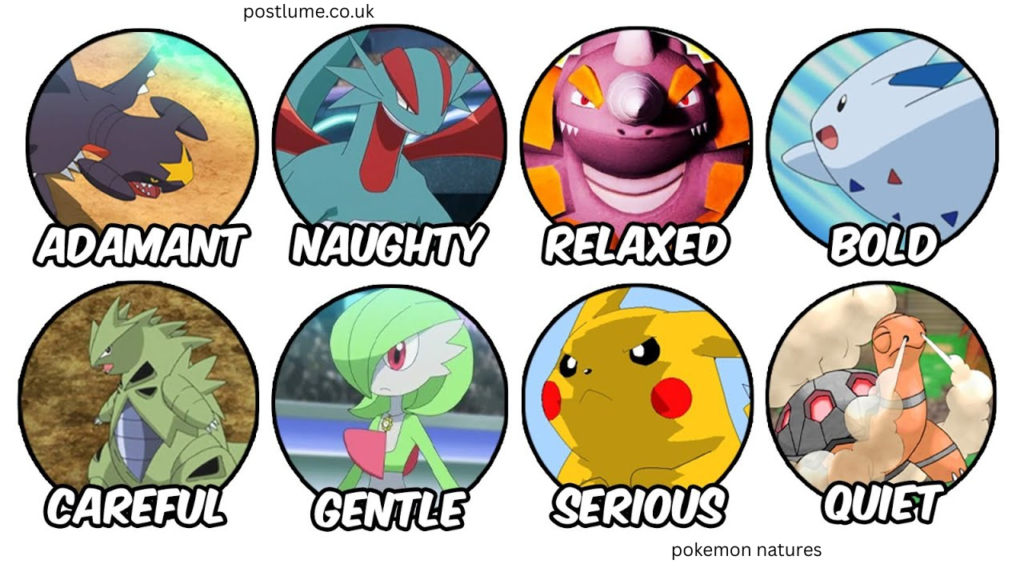
How Nature Affects Stats (The Math)
Nature applies a flat 10% multiplier — a 1.1x increase to the boosted stat, and a 0.9x decrease to the lowered stat. The formula for non-HP stats looks like this:
Stat = (((2 × Base + IV + EV/4) × Level / 100) + 5) × Nature Modifier
So for a Level 100 Garchomp with a base Speed of 102, an IV of 31, and 252 EVs invested in Speed:
- Without a beneficial nature: 189 Speed
- With Jolly (Speed-boosting): 207 Speed
That 18-point gap is often the difference between outspeeding a key threat and getting hit first. At high-level competitive play, that gap decides games.
How to Determine a Pokémon’s Nature
A Pokémon’s nature is set randomly when it’s generated, unless something specifically controls it. Here’s how nature gets determined by generation:
- Generations III–V: Nature is tied to the Pokémon’s personality value, generated randomly at encounter or hatch — unless the Synchronize ability is active on the lead party Pokémon, which locks a 50% chance (100% in Gen VI onward) that the wild or hatched Pokémon shares that nature.
- Generation VI onward: Nature became a separate stored value rather than being derived from the personality value, but Synchronize still works the same way.
- Breeding: If a parent holds an Everstone, there’s a high chance the offspring inherits that parent’s exact nature.
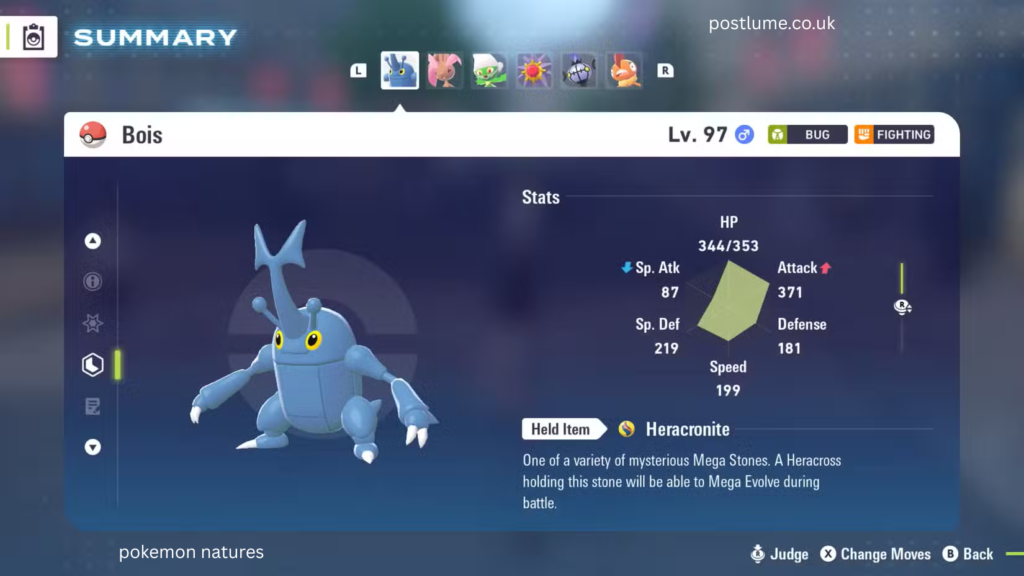
To check a Pokémon’s nature in-game, open its Summary screen and look at the stats page — the game describes it in a short flavor line (for example, “likes to relax” for Bold) and, in newer titles, states the nature by name directly.
How to Choose the Right Nature for Your Pokémon
Pick a nature based on the role you want the Pokémon to fill, not just its typing. Ask two questions: what stat does this Pokémon rely on most, and what stat does it not need?
Physical attackers — Look for a nature that raises Attack and lowers a stat you don’t use, most often Sp. Attack.
- Adamant (+Atk, -SpA): standard pick for slower physical attackers
- Jolly (+Spe, -SpA): for physical attackers that also want to outspeed threats
Special attackers — Same logic, aimed at Sp. Attack.
- Modest (+SpA, -Atk): standard pick for slower special attackers
- Timid (+Spe, -Atk): for special attackers built around speed
Walls and tanks — Prioritize a defensive stat over offense.
- Bold (+Def, -Atk): physical walls
- Calm (+SpD, -Atk): special walls
Support Pokémon — Usually favor bulk or Speed depending on whether the Pokémon needs to move first (to set hazards or status) or needs to survive hits to keep functioning.
- Timid or Jolly for support Pokémon that need to act before the opponent
- Careful or Calm for support Pokémon meant to take hits and stay on the field
Best Natures by Popular Pokémon Roles
Sweepers (Pokémon meant to knock out multiple opponents in a row): Jolly or Adamant for physical sweepers like Garchomp; Timid or Modest for special sweepers like Alakazam.
Walls/Stall (Pokémon meant to absorb hits and outlast opponents): Bold or Calm, paired with a Pokémon that already has strong base defensive stats, like Blissey or Toxapex.
Trick Room teams (teams built around slow Pokémon moving first): Brave or Quiet — natures that lower Speed on purpose, since Trick Room reverses turn order.
Mixed attackers (Pokémon using both physical and special moves): Naive or Rash, which raise Speed or Sp. Attack respectively while lowering a defensive stat instead of an offensive one.
Can You Change a Pokémon’s Nature?
Yes. Starting in Generation VIII (Sword and Shield), Mints let you change how a Pokémon’s stats are boosted and lowered by nature without touching the nature’s name or its in-game description. Buy or find a Mint that matches the nature effect you want, use it on your Pokémon from the item menu, and the stat calculation updates immediately — no breeding required.
This means you no longer have to hatch dozens of eggs chasing a specific nature. Catch or breed for good IVs first, then use a Mint to lock in the stat spread you actually need.

Frequently Asked Questions
Does nature affect catch rate or encounter rate? No. Nature has zero effect on how easy a Pokémon is to catch or how often it appears in the wild. It’s a common mix-up, but catch rate depends on the Pokémon’s catch rate stat, HP remaining, status conditions, and the Poké Ball used — not nature.
What’s the difference between nature and characteristic? Nature is a fixed trait that changes actual stat values. Characteristic is a flavor text hint shown on a Pokémon’s summary page that points to its highest IV — it doesn’t affect stats at all, and can even belong to a Pokémon with a neutral nature.
Does nature matter in casual, non-competitive play? It matters less, but it’s not nothing. Even in a normal playthrough, a Pokémon with a nature that works against its main stat can feel noticeably weaker in tough fights, especially against gym leaders or rivals with well-built teams.
What’s the best nature for Garchomp? Jolly is the standard pick for a physical attacking Garchomp that wants to outspeed as many threats as possible; Adamant works if you’re running Choice Band or Trick Room support and don’t need the extra Speed.
What’s the best nature for Charizard? Depends on the build — Timid works for a special-attacking Charizard (especially with Mega Charizard Y or Tera options), while Jolly suits a physical set built around moves like Flare Blitz.
Related Tools
- IV Calculator — check your Pokémon’s hidden individual values
- EV Calculator — plan out effort value spreads for competitive builds
- Nature Calculator — confirm a Pokémon’s nature from its stats and characteristic
Have a nature question we didn’t cover? Drop it in the comments and we’ll add it to the FAQ.
