



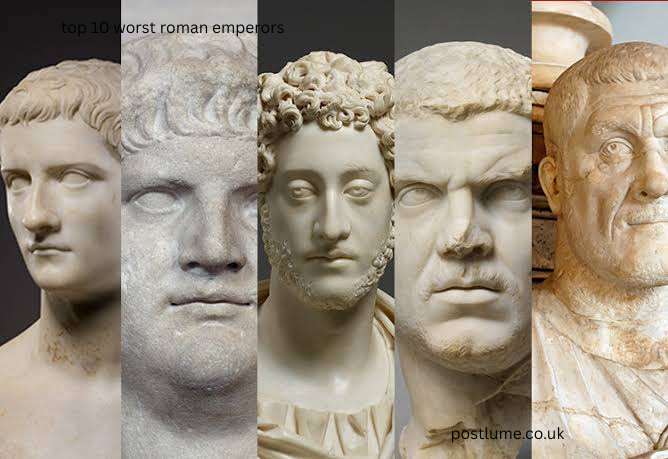
The history of the Roman Empire is filled with legendary rulers who expanded territories, built magnificent monuments, and established lasting reforms. However, not every emperor left behind a legacy worth celebrating. Some were remembered for cruelty, incompetence, political instability, economic mismanagement, or outright madness. That’s why the topic of the top 10 worst Roman emperors continues to fascinate historians, students, and history enthusiasts alike.
From tyrannical rulers who terrorized their citizens to leaders whose poor decisions weakened one of history’s greatest civilizations, these emperors demonstrate how ineffective leadership can have lasting consequences. While some stories have undoubtedly been exaggerated by ancient historians, there is little doubt that several Roman rulers caused enormous damage during their reigns.
This article explores ten emperors widely regarded as among Rome’s least successful leaders, explains why they earned such reputations, and examines the lessons their reigns continue to teach about leadership, power, and governance.
How Historians Judge Roman Emperors
Before ranking these rulers, it’s important to understand that ancient historical sources often contained political bias.
Historians generally evaluate emperors based on:
- Military leadership
- Economic management
- Political stability
- Treatment of citizens
- Administrative reforms
- Foreign policy
- Public works
- Long-term impact
Although opinions sometimes differ, certain rulers consistently appear on lists of Rome’s worst leaders.
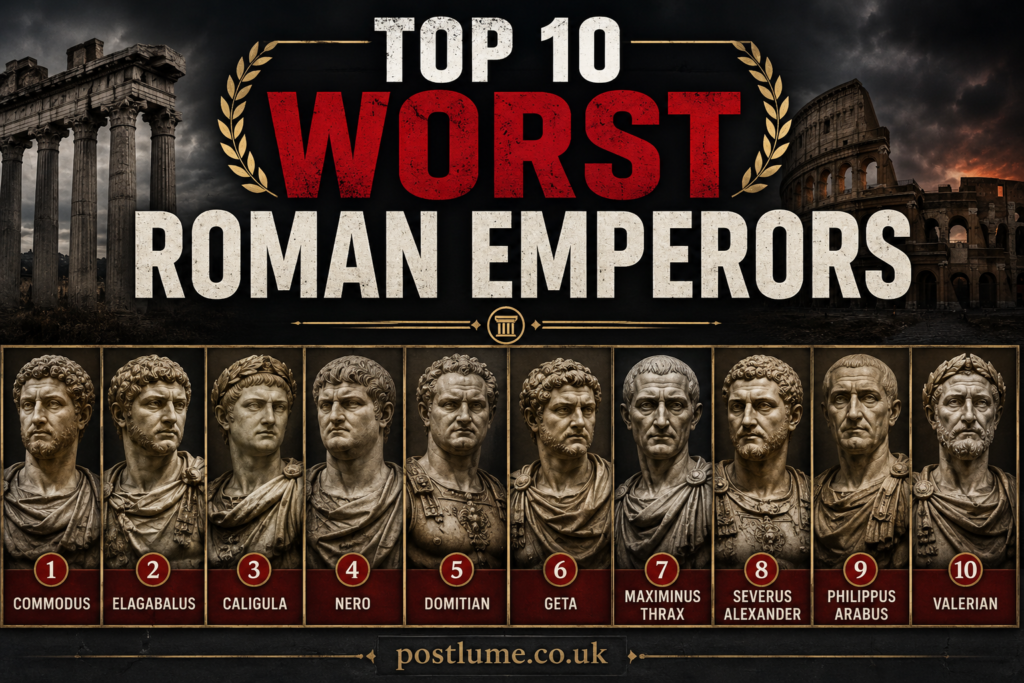
The Top 10 Worst Roman Emperors
1. Caligula (37–41 AD)
Few Roman emperors have become as infamous as Caligula.
His reign has been associated with:
- Extreme cruelty
- Political executions
- Lavish spending
- Public humiliation of senators
- Alleged erratic behavior
While some accounts may be exaggerated, his leadership created instability throughout the empire.
2. Nero (54–68 AD)
Nero remains one of Rome’s most controversial rulers.
His reign included:
- Political persecution
- Financial problems
- Major rebuilding projects
- Growing public unrest
- Rebellions throughout the empire
Although modern historians debate certain stories surrounding the Great Fire of Rome, his administration ended in chaos.
3. Commodus (177–192 AD)
The son of Marcus Aurelius, Commodus inherited a stable empire.
Instead of strengthening it, he became known for:
- Political favoritism
- Gladiator performances
- Government corruption
- Weak administration
- Poor decision-making
His assassination marked the beginning of significant political instability.
4. Elagabalus (218–222 AD)
Ascending to power as a teenager, Elagabalus shocked Roman society.
Criticism focused on:
- Religious controversies
- Court scandals
- Political inexperience
- Administrative neglect
His reign lasted only four years before his assassination.
5. Caracalla (198–217 AD)
Caracalla is remembered for both notable reforms and extreme brutality.
His rule featured:
- Heavy taxation
- Military spending
- Political violence
- Elimination of rivals
Although he expanded Roman citizenship, his violent leadership overshadowed many accomplishments.
6. Maximinus Thrax (235–238 AD)
Maximinus rose through the military rather than the aristocracy.
His government struggled because of:
- High taxes
- Military dependence
- Provincial unrest
- Political opposition
His reign marked the beginning of the Crisis of the Third Century.
7. Didius Julianus (193 AD)
Perhaps no emperor gained power in a more controversial way.
Following political turmoil, Julianus effectively purchased the throne.
Consequences included:
- Public outrage
- Loss of legitimacy
- Civil conflict
- Short reign
He ruled for only a few months.
8. Honorius
Although not personally cruel, Honorius presided over one of Rome’s most difficult periods.
Major events included:
- Barbarian invasions
- Declining military strength
- Administrative failures
- The sack of Rome in 410 AD
His inability to respond effectively weakened the Western Empire.
9. Valerian
Valerian faced enormous external challenges.
His reign ended dramatically when he was captured during war against the Persian Empire.
His defeat damaged Roman prestige and exposed military weaknesses.
10. Vitellius
Vitellius ruled during the chaotic Year of the Four Emperors.
His government suffered from:
- Civil war
- Financial instability
- Weak political alliances
- Administrative disorder
His reign lasted less than one year.
Why These Emperors Failed
Although each ruler governed under different circumstances, several common patterns emerge.
Poor Leadership
Effective leadership requires vision and accountability.
Many failed to provide either.
Political Violence
Assassinations and purges created instability.
Economic Mismanagement
Heavy taxation and reckless spending weakened the empire.
Military Problems
Strong armies require capable leadership.
Several emperors neglected military priorities.
Loss of Public Trust
Without legitimacy, governments struggle to survive.
Characteristics Shared by Ineffective Emperors
| Characteristic | Impact on Rome |
|---|---|
| Corruption | Reduced public confidence |
| Overspending | Economic decline |
| Political instability | Frequent rebellions |
| Weak administration | Government inefficiency |
| Poor military leadership | Territorial losses |
| Personal extravagance | Public resentment |
Leadership Lessons From Roman History
Studying unsuccessful rulers provides valuable insights.
Important lessons include:
- Accountability matters.
- Financial discipline is essential.
- Strong institutions outlast individuals.
- Public trust is difficult to rebuild.
- Competent advisors improve decision-making.
- Leadership requires responsibility, not simply authority.
Why Roman History Still Matters
Ancient Rome continues influencing modern society.
Its legacy includes:
- Legal systems
- Government structures
- Military organization
- Engineering achievements
- Architecture
- Political philosophy
- Public administration
Studying both successful and unsuccessful emperors helps historians understand how civilizations rise and decline.
Why Choose Historical Analysis?
Examining history offers numerous benefits.
Better Critical Thinking
Historical evidence encourages careful evaluation.
Leadership Insights
Ancient examples remain relevant today.
Understanding Political Change
History reveals how governments evolve.
Appreciating Cultural Heritage
Roman civilization shaped much of the modern Western world.
Benefits for Students and Researchers
Learning about Roman emperors helps develop:
- Historical knowledge
- Analytical skills
- Research abilities
- Source evaluation
- Critical reasoning
These skills extend far beyond the study of ancient history.
Myths Versus Reality
Ancient historians sometimes exaggerated the behavior of unpopular emperors.
Modern scholars compare multiple sources, archaeological evidence, and historical context before reaching conclusions.
As a result, certain dramatic stories should be viewed with caution.
Nevertheless, enough evidence exists to conclude that many rulers genuinely governed poorly.
Frequently Asked Questions
Who was the worst Roman emperor?
Many historians consider Caligula, Nero, or Commodus among the worst because of political instability, cruelty, and ineffective leadership.
Why is the topic of the top 10 worst Roman emperors so popular?
People enjoy exploring how poor leadership influenced one of history’s greatest civilizations and contributed to political decline.
Were ancient historians always accurate?
No. Many ancient writers had political biases, so modern historians compare multiple sources before drawing conclusions.
Did every unpopular emperor deserve their reputation?
Not necessarily. Some reputations were influenced by political propaganda, while others were supported by substantial historical evidence.
What can we learn from the top 10 worst Roman emperors?
The top 10 worst Roman emperors demonstrate the importance of responsible leadership, sound economic management, military competence, and maintaining public trust.
Conclusion
The top 10 worst Roman emperors remind us that even the most powerful empire in the ancient world was vulnerable to poor leadership. Whether through corruption, cruelty, financial mismanagement, military failures, or political instability, these rulers left lasting marks on Roman history—often for the wrong reasons.
At the same time, studying their reigns provides valuable lessons that extend far beyond ancient Rome. Effective leadership depends on accountability, thoughtful decision-making, strong institutions, and the ability to earn public confidence. By examining both Rome’s greatest achievements and its greatest failures, we gain a deeper understanding of how civilizations flourish—and how they can decline.
If you’re passionate about ancient history, exploring the lives of these controversial rulers offers fascinating insight into one of the world’s most influential empires and the enduring lessons it continues to teach.
